
Plan for the Equitable Distribution of Social Services in Ottawa
SEPAW | April 16, 2026
The Centretown Community Association (CCA) supports calls from Lowertown Community Association and Action Sandy Hill for a more equitable distribution of social services across all 24 wards of Ottawa. While more supports for homelessness, addiction and mental health are vitally needed, ensuring fair access to these supports across the city is essential for the safety and well-being of both at-risk individuals and the communities that host these services. This statement pertains to proposals for new or expanded services.
A Compassionate Community Under Strain
Centretown has long been a vibrant, diverse, and inclusive neighbourhood, home to people of varied incomes, ages and cultures as well as Chinatown and the 2SLGBTQIA+ Village. For decades, Centretown has provided social services support to individuals who are street-involved, under-housed, or experiencing substance use disorders or mental illness. Centretown takes pride in being a compassionate community.
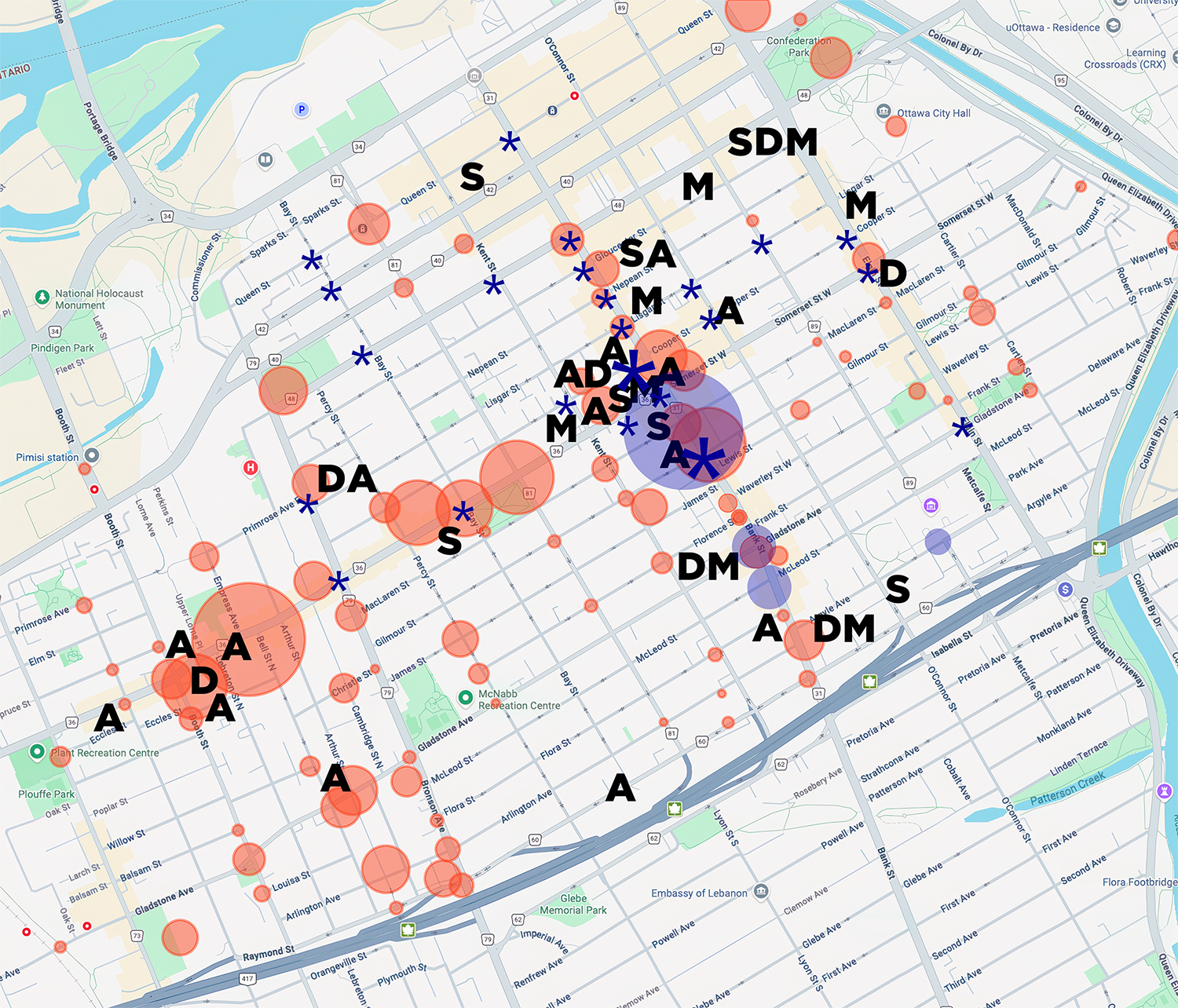
The escalating homelessness, mental health and addiction crises have contributed to crime and social disorder “hot spots” in Centretown, where many residents, workers, business owners, pedestrians and visitors feel unsafe. Located along Bank Street and Somerset Street west of Bank, these hot spots have high concentrations of crime and open drug use reflected by discarded drug paraphernalia, as shown in Annex 1. These safety concerns weaken the vibrancy, livability and vitality of these areas.
Ottawa’s social services, including low-barrier supports for homelessness and addiction are primarily concentrated in Somerset and Rideau-Vanier Wards. Somerset Ward hosts a dense network of services related to addiction (e.g. prescription/dispensing of opioids, distributing needles and inhalation supplies), emergency food supply, emergency shelters, drop-in centres and other outreach services for at-risk populations i. This includes 10 Ottawa Public Health harm-reduction partner locations, representing 46% of the city’s total despite representing only 4.5% of Ottawa’s population ii. Annex 1 shows that these supports are located around the hot spots noted above, primarily along Bank and Somerset streets.
Over-concentration of Social Services Harms At-risk Populations
While often assumed to reflect local need, evidence indicates that many at-risk clients are drawn downtown from across Ottawa and surrounding regions due to the lack of services elsewhere iii. While supports for homelessness, addiction and mental health are vitally needed, the overconcentration of services in downtown hubs leads to unintended harms to their clients:
• Displaces people from their home communities, severing family, cultural, and support networks critical to recovery.
• Exposes vulnerable individuals to increased risks of violence, exploitation, and criminal activity.
• Attracts drug dealers and predators to areas where large numbers of street-involved people congregate
• Undermines the effectiveness of services by creating environments that entrench cycles of harm rather than supporting recovery, such as increased use of illicit substances and potentially toxic drug supply.
Neighbourhood Safety Concerns
The community impacts are measurable and significant:
In 2024, Somerset Ward had the highest per capita crime rate in Ottawa—more than 3.5 times the city average—with violent and non-violent crime increasing faster than citywide trends iv. Crimes are most concentrated in the hot spots shown in Annex 1, including drug dealer related shootings and stabbings.
In 2024, over 12,000 discarded needles and pipes were recovered (53% increase from 2023)v, with high concentration along Bank St. and Somerset St.
Many vacant offices and storefronts dot Bank Street and Chinatown as businesses leave, in part, due to difficulty keeping workers and customers due to safety concerns, while costs for security and clean-up increase vi. Vacancies reduce the safety effect of “eyes on the street” adding to the perceptions of urban decline.
Safety concerns are felt by children, workers, seniors, pedestrians, women, racialized people, members of the 2SLGBTQIA+ community, and low-income residents who cannot afford to move to safer locations. Typically, impacted people are not consulted in decisions to locate new services that affect their exposure to harm, such as drug dealing and crime.
A Better Approach: Supportive Housing with Wraparound Supports
Evidence shows that outcomes improve when services are delivered through stable housing with wraparound supports. To ensure accessibility, these supports should be located in transit hubs and clients should be issued free transit passes. This approach promotes dignity, safety, recovery, and better integration into neighbourhoods across the city, while reducing the harm associated with low-barrier service overconcentration.
CCA Calls to Action
The CCA urges City Council and staff to ensure all wards share responsibility for supporting mental health, addiction, and homelessness services by:
Reducing the need for at-risk populations to disconnect from their local community supports by developing and implementing a city-wide strategy to equitably distribute social services and reduce the concentration currently borne by wards 12 and 14.
Prioritizing Housing First, with supportive and transitional housing available across the city to provide stability for individuals seeking to exit homelessness.
Advocating for integrated case management across service streams and providers to ensure coordinated care and regional responsibility.
Requiring community safety impact assessments and Community Engagement Plans for all proposed new or expanded social services to avoid overconcentration and resulting safety concerns.
We also urge provincial and federal governments to support equitable service distribution within their jurisdictions, including by providing adequate and sustainable funding for the systematic coordination of care.
i 7 Emergency Shelter/Transitional Housing, 7 Drop-In Centers, 8 Addiction Service Providers, 8 Emergency Meals (information compiled by the CCA’s Safety, Emergency Preparedness and Wellness Working Group)
ii Harm Reduction partner data is from https://www.ottawapublichealth.ca/en/public-health-topics/harm reduction-services-in-ottawa.aspx#Partner-agencies--Pharmacy-partners. Population data is from Ottawa Neighbourhood Survey: ons-sqo.ca/maps
iii CBC interview “Homeless agencies squeezed by people coming in from out-of-town” (July 31, 2025), Ottawa Police Chief Eric Stubbs and Kaite Burkholder Harris, Executive Director of the Alliance to End Homelessness, https://www.cbc.ca/listen/live-radio/1-92-all-in-a-day/clip/16161236-homeless-agencies-squeezed-people coming-out-of-town
iv Ottawa Police Service Crime Data Portal.
v Ottawa Public Health, Community Needle Retrieval Dashboard, Recovered Needles and Glass Pipes, 2024.
vi Yukang Li, Executive Director, Somerset Street Chinatown BIA, Opinion: Ottawa Citizen, September 5, 2025, “Here's what crime is really like in Ottawa's Chinatown”
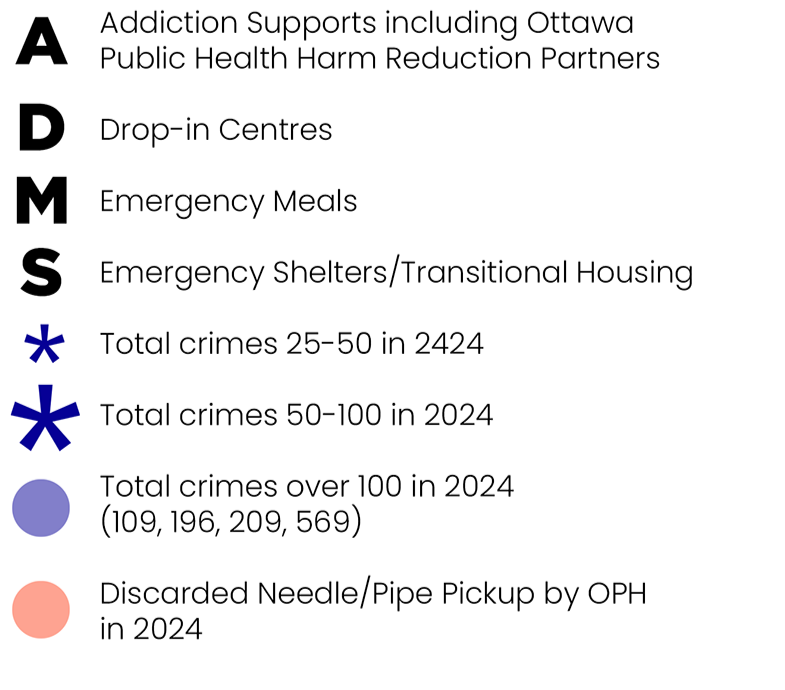
Annex 1 : Crime and Discarded Drug Paraphernalia Hot Spots (2024) and Social Servies in Somerset Ward
Data Sources:
Discarded Drug Paraphernalia: Ottawa Public Health, Community Needle Retrieval Dashboard, Recovered Needles and Glass Pipes, 2024.
Crime Data: Ottawa Police Services Crime Data Portal, 2024
Services locations: compiled by CCA SEPAW Working Group.