
Recent Advocacy
CCA expresses disappointment by the lack of consultation in Ottawa’s return to office traffic plan.
Transportation | September 2, 2026
Dear Mayor Sutcliffe,
The Centretown Community Association is disappointed by the lack of consultation, and true solutions included in Ottawa’s return to office traffic plan, officially known as the Transportation and Mobility Strategy and Action Plan.
Transportation | September 2, 2026
Dear Mayor Sutcliffe,
The Centretown Community Association is disappointed by the lack of consultation, and true solutions included in Ottawa’s return to office traffic plan, officially known as the Transportation and Mobility Strategy and Action Plan.
The plan provides very little real solutions for addressing traffic congestion and an influx of cars in the downtown area. Many of the plan’s areas of focus are redundant, or identify projects a functioning city should already be doing, like ensuring bike lanes are well maintained and swept. On a plan that aims to implement all feasible measures by September 1, 2026, two thirds of the plan's funding is being spent on the Suburban Bowesville Park and Ride expansion that will not be complete until 2027.
We are especially concerned by the lack of consultation for what is being presented as a significant plan. This plan was not originally presented at a city committee, meaning residents were not given the opportunity to delegate or consult on the project. Changes like allowing private driveway rentals will have a profound and lasting impact on our neighbourhood, and deserved to be discussed ahead of time. Return to office is not a surprise development; proper consultation with local residents and commuters should have been an essential part of a functional plan.
We are also concerned by the lack of investments in Centretown and across downtown that this plan provides. Somerset Ward residents will bear the significant brunt of the additional traffic, air pollution, and road safety concerns. We are disappointed to see no significant investments in cycling infrastructure, bus lanes or similar transit priority measures, or road safety measures included as part of the plan. Instead, critical infrastructure works downtown, like on Bay Street, are being delayed so more commuters can drive past our doors.
Ottawa’s return to office traffic plan doesn’t serve downtown residents, and will lead to more traffic congestion, more road safety concerns, and more unreliable public transit in Centretown. We urge you to rethink this plan, so we can have a plan that works for all of Ottawa.
Thank you,
Martin Barclay
CCA President
Plan for the Equitable Distribution of Social Services in Ottawa
SEPAW | April 16, 2026
The Centretown Community Association (CCA) supports calls from Lowertown Community Association and Action Sandy Hill for a more equitable distribution of social services across all 24 wards of Ottawa. While more supports for homelessness, addiction and mental health are vitally needed, ensuring fair access to these supports across the city is essential for the safety and well-being of both at-risk individuals and the communities that host these services. This statement pertains to proposals for new or expanded services.
SEPAW | April 16, 2026
The Centretown Community Association (CCA) supports calls from Lowertown Community Association and Action Sandy Hill for a more equitable distribution of social services across all 24 wards of Ottawa. While more supports for homelessness, addiction and mental health are vitally needed, ensuring fair access to these supports across the city is essential for the safety and well-being of both at-risk individuals and the communities that host these services. This statement pertains to proposals for new or expanded services.
A Compassionate Community Under Strain
Centretown has long been a vibrant, diverse, and inclusive neighbourhood, home to people of varied incomes, ages and cultures as well as Chinatown and the 2SLGBTQIA+ Village. For decades, Centretown has provided social services support to individuals who are street-involved, under-housed, or experiencing substance use disorders or mental illness. Centretown takes pride in being a compassionate community.
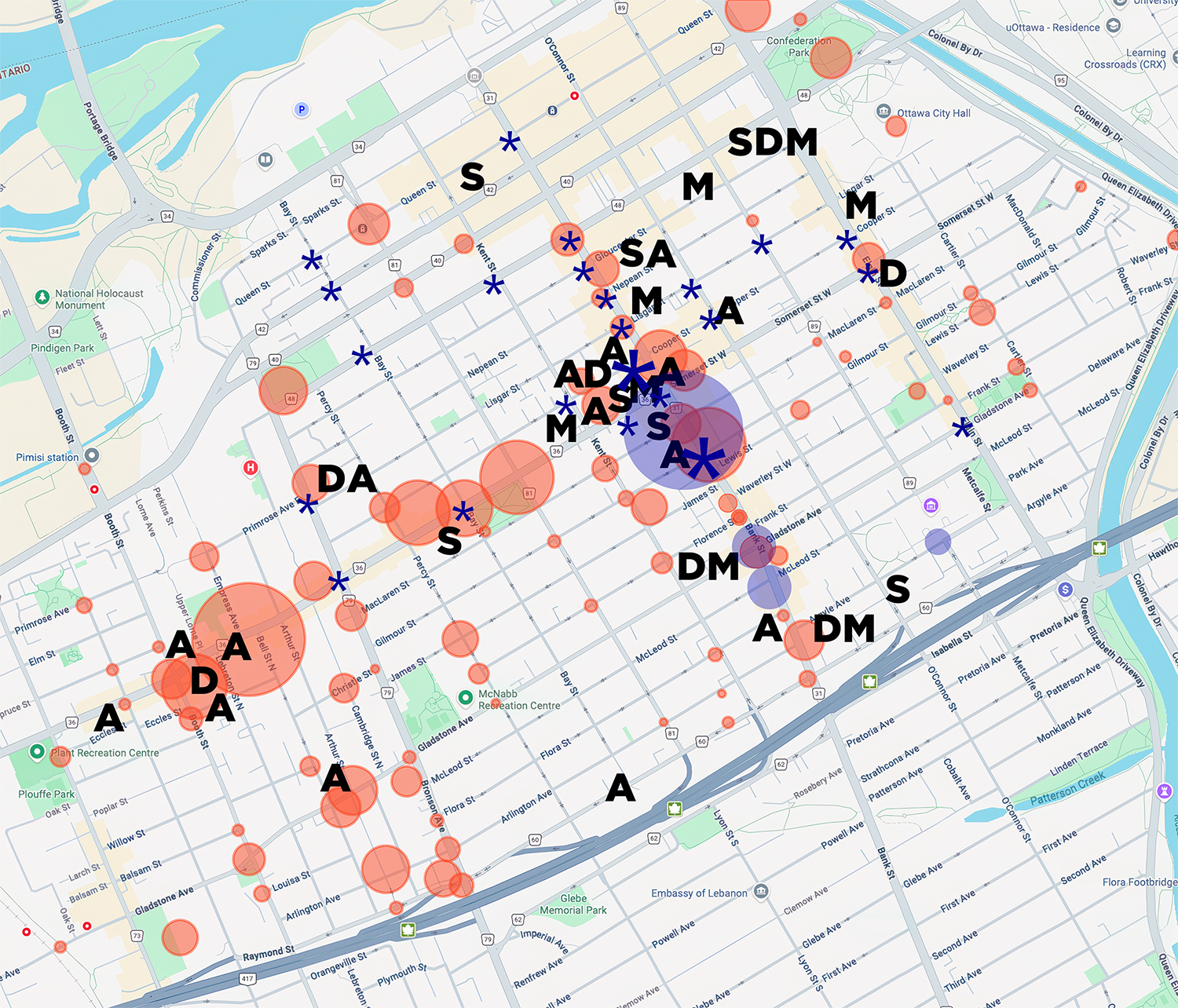
The escalating homelessness, mental health and addiction crises have contributed to crime and social disorder “hot spots” in Centretown, where many residents, workers, business owners, pedestrians and visitors feel unsafe. Located along Bank Street and Somerset Street west of Bank, these hot spots have high concentrations of crime and open drug use reflected by discarded drug paraphernalia, as shown in Annex 1. These safety concerns weaken the vibrancy, livability and vitality of these areas.
Ottawa’s social services, including low-barrier supports for homelessness and addiction are primarily concentrated in Somerset and Rideau-Vanier Wards. Somerset Ward hosts a dense network of services related to addiction (e.g. prescription/dispensing of opioids, distributing needles and inhalation supplies), emergency food supply, emergency shelters, drop-in centres and other outreach services for at-risk populations i. This includes 10 Ottawa Public Health harm-reduction partner locations, representing 46% of the city’s total despite representing only 4.5% of Ottawa’s population ii. Annex 1 shows that these supports are located around the hot spots noted above, primarily along Bank and Somerset streets.
Over-concentration of Social Services Harms At-risk Populations
While often assumed to reflect local need, evidence indicates that many at-risk clients are drawn downtown from across Ottawa and surrounding regions due to the lack of services elsewhere iii. While supports for homelessness, addiction and mental health are vitally needed, the overconcentration of services in downtown hubs leads to unintended harms to their clients:
• Displaces people from their home communities, severing family, cultural, and support networks critical to recovery.
• Exposes vulnerable individuals to increased risks of violence, exploitation, and criminal activity.
• Attracts drug dealers and predators to areas where large numbers of street-involved people congregate
• Undermines the effectiveness of services by creating environments that entrench cycles of harm rather than supporting recovery, such as increased use of illicit substances and potentially toxic drug supply.
Neighbourhood Safety Concerns
The community impacts are measurable and significant:
In 2024, Somerset Ward had the highest per capita crime rate in Ottawa—more than 3.5 times the city average—with violent and non-violent crime increasing faster than citywide trends iv. Crimes are most concentrated in the hot spots shown in Annex 1, including drug dealer related shootings and stabbings.
In 2024, over 12,000 discarded needles and pipes were recovered (53% increase from 2023)v, with high concentration along Bank St. and Somerset St.
Many vacant offices and storefronts dot Bank Street and Chinatown as businesses leave, in part, due to difficulty keeping workers and customers due to safety concerns, while costs for security and clean-up increase vi. Vacancies reduce the safety effect of “eyes on the street” adding to the perceptions of urban decline.
Safety concerns are felt by children, workers, seniors, pedestrians, women, racialized people, members of the 2SLGBTQIA+ community, and low-income residents who cannot afford to move to safer locations. Typically, impacted people are not consulted in decisions to locate new services that affect their exposure to harm, such as drug dealing and crime.
A Better Approach: Supportive Housing with Wraparound Supports
Evidence shows that outcomes improve when services are delivered through stable housing with wraparound supports. To ensure accessibility, these supports should be located in transit hubs and clients should be issued free transit passes. This approach promotes dignity, safety, recovery, and better integration into neighbourhoods across the city, while reducing the harm associated with low-barrier service overconcentration.
CCA Calls to Action
The CCA urges City Council and staff to ensure all wards share responsibility for supporting mental health, addiction, and homelessness services by:
Reducing the need for at-risk populations to disconnect from their local community supports by developing and implementing a city-wide strategy to equitably distribute social services and reduce the concentration currently borne by wards 12 and 14.
Prioritizing Housing First, with supportive and transitional housing available across the city to provide stability for individuals seeking to exit homelessness.
Advocating for integrated case management across service streams and providers to ensure coordinated care and regional responsibility.
Requiring community safety impact assessments and Community Engagement Plans for all proposed new or expanded social services to avoid overconcentration and resulting safety concerns.
We also urge provincial and federal governments to support equitable service distribution within their jurisdictions, including by providing adequate and sustainable funding for the systematic coordination of care.
i 7 Emergency Shelter/Transitional Housing, 7 Drop-In Centers, 8 Addiction Service Providers, 8 Emergency Meals (information compiled by the CCA’s Safety, Emergency Preparedness and Wellness Working Group)
ii Harm Reduction partner data is from https://www.ottawapublichealth.ca/en/public-health-topics/harm reduction-services-in-ottawa.aspx#Partner-agencies--Pharmacy-partners. Population data is from Ottawa Neighbourhood Survey: ons-sqo.ca/maps
iii CBC interview “Homeless agencies squeezed by people coming in from out-of-town” (July 31, 2025), Ottawa Police Chief Eric Stubbs and Kaite Burkholder Harris, Executive Director of the Alliance to End Homelessness, https://www.cbc.ca/listen/live-radio/1-92-all-in-a-day/clip/16161236-homeless-agencies-squeezed-people coming-out-of-town
iv Ottawa Police Service Crime Data Portal.
v Ottawa Public Health, Community Needle Retrieval Dashboard, Recovered Needles and Glass Pipes, 2024.
vi Yukang Li, Executive Director, Somerset Street Chinatown BIA, Opinion: Ottawa Citizen, September 5, 2025, “Here's what crime is really like in Ottawa's Chinatown”
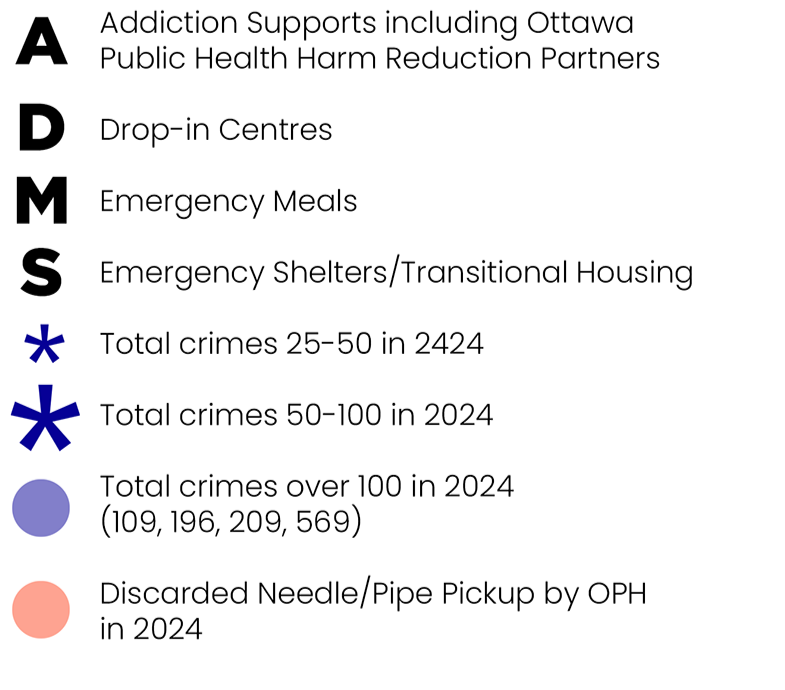
Annex 1 : Crime and Discarded Drug Paraphernalia Hot Spots (2024) and Social Servies in Somerset Ward
Data Sources:
Discarded Drug Paraphernalia: Ottawa Public Health, Community Needle Retrieval Dashboard, Recovered Needles and Glass Pipes, 2024.
Crime Data: Ottawa Police Services Crime Data Portal, 2024
Services locations: compiled by CCA SEPAW Working Group.
Letter from the President to AGCO Regarding Dime and Dash
SEPAW | February 23, 2026
Dear Registrar,
I am a resident of Ottawa and President of the Centretown Community Association (CCA), whose members live, work or own property or businesses in the neighourhood of Centretown. I am writing to submit this formal objection to the proposed cannabis retail store at 366 Bank Street.
February 23, 2026
To: Alcohol and Gaming Commission of Ontario (AGCO)
Re: File No. 3480064 - Dime & Dash, 366 Bank St. Ottawa
Dear Registrar,
I am a resident of Ottawa and President of the Centretown Community Association (CCA), whose members live, work or own property or businesses in the neighourhood of Centretown. I am writing to submit this formal objection to the proposed cannabis retail store at 366 Bank Street.
The proposed location is within Somerset Ward, one of Ottawa's downtown wards, which includes the neighbourhood of Centretown. This submission is made pursuant to the AGO's public-interest mandate, with particular concern for public safety, protection of youth, and impact on vulnerable populations.
The proposed site sits along Bank Street, a commercial corridor, that has been experiencing significant social, health, and public safety pressures (map provided). Based on cumulative conditions outlined below, the CCA believes this location is not appropriate for an additional cannabis retail outlet.
Proximity to Schools and Youth Activity
Glashan Public School (grades 7 and 8) is located approximately 600 metres from the proposed site. Elgin Street Public School (elementary school) is three blocks east (500 metres) of the proposed site. Both schools are within walking distance of the proposed location and students living to the east and west of Bank St. regularly cross the signalized Bank and Gilmour intersection, immediately adjacent to the site, as part of their daily travel between school and surrounding residential streets. Parents have raised concerns about the safety of children using that intersection due to social disorder, drug related issues including drug dealing and related violence and frequent encampments in front of the proposed site. A number of daycares also operate nearby.
Bank Street functions as a primary pedestrian corridor for residents and is a major transit and business corridor. Locating a cannabis retail store at this site would place it directly along routes routinely used by children, increasing their exposure during daily school travel and pedestrian activity.
Public Safety and Crime Concentration
Somerset Ward has the highest crime rate in Ottawa, with a crime rate that is over 3 times the Ottawa average. The proposed site is located within a well-documented high-crime corridor. The intersections between Bank/Cooper St. and Bank/Catherine St., less than 1 km stretch, contains seven of the ten highest-crime intersections in Somerset Ward.
The proposed location at Bank and Gilmour is in the middle of this corridor and it is well known in the community that it is a problematic intersection. Ottawa Police Service 2024 crime data (which reports by intersection) indicates that 51 crimes were reported in and around the intersection of the proposed site, including 11 assaults. The highest crime incidents occurred a block away at Bank and Maclaren, where 569 incidents were reported, including 16 assaults.
Residents, businesses and visitors along this portion of Bank Street report ongoing concerns about drug dealing, public drug use, aggressive behaviour and violence, street disorder, and other public safety challenges. The area is already under significant pressure from social and public-safety challenges.
Substance Use Activity and Vulnerable Populations
The Bank and Gilmour area has been experiencing substantial substance-use-related pressures. For 2025, Ottawa Public Health reports that over 1000 discarded needles/pipes were collected at the Bank/Gilmour intersection. Ottawa Public Health and community partners conduct ongoing harm-reduction outreach along the Bank Street corridor, reflecting the concentration of need in this area Residents and local businesses regularly report open substance use, public intoxication, discarde paraphernalia, and related disorder conditions. The intersection is also less than 100 metres from supportive housing which houses some of the most marginalized members of our community, some of whom live with complex mental and/or physical health challenges.
The neighbourhood is already under significant social and public-health strain.
Existing Cannabis Retail Concentration
Multiple cannabis retail stores already operate within a short distance of the proposed location, including:
Hunny Pot Cannabis - 206 Bank Street (450 metres)
Cannabis Emporium - 243 Bank Street (300 metres)
OC Barrymore Emporium - 325 Bank Street (45 metres)
Bytown Budz- 373 Somerset Street (210 metres)
The presence of several existing cannabis retailers within a short stretch indicates that local demand is
already being served. Additional approvals would further concentrate cannabis retail activity in an area
already experiencing cumulative pressures.
Conclusion
The proposed cannabis retail outlet at 366 Bank Street is located within a cumulative high-risk environment as noted above. Taken together, these factors raise serious concerns regarding public safety, youth exposure, and the cumulative impact on a neighbourhood already under significant strain.
For these reasons, the Centretown Community Association strongly urges the AGO to reject this application in the public interest.
Thank you for your consideration.
Sincerely,
Rob Dokker, President
Centretown Community Association
CC:
Ariel Troster, Councillor, Somerset Ward
Catherine McKenney, MPP Parliament
Community Conversation on Homelessness
Housing Affordability | February 3, 2026
On February 5, community members, service providers and elected officials are invited to come together for a follow up Community Conversation on Homelessness in Ottawa. The event will take place in-person, providing a platform for open dialogue, sharing ideas and creating solutions to address the ongoing homelessness crisis.
Housing Affordability | February 3, 2026
OTTAWA, ON — On February 5, community members, service providers and elected officials are invited to come together for a follow up Community Conversation on Homelessness in Ottawa. The event will take place in-person, providing a platform for open dialogue, sharing ideas and creating solutions to address the ongoing homelessness crisis.
We have 2 featured speakers to outline their model in Toronto and Ottawa. They will then be joined in a panel discussion by 3 elected officials:
• Keith Hambly, CEO of Fred Victor in Toronto (operates Dunn House)
• Rob Boyd, CEO of Ottawa Inner City Health
• MP Yasir Naqvi
• MPP Catherine McKenney
• Somerset Councillor Ariel Troster
The Centretown Community Conversation on Homelessness in January 2025 was covered by CTV and an article in the Ottawa Citizen.
WHO Centretown Community Association, Glebe Community Association, Lowertown Community Association, Action Sandy Hill, Dalhousie Community Association and support from Centretown Community Health Centre and a number of sponsors
WHAT Community Conversation on Homelessless
WHEN February 5, 2026 6-8pm
WHERE Knox Presbyterian Church, 120 Lisgar St. Ottawa
RSVP for a ticket at https://www.eventbrite.ca/e/1980101411625?aff=Press
For more information, please contact Mary Huang from the Centretown Community Association at maryhuanggd@gmail.com.
About the Centretown Community Association
The Centretown Community Association (CCA) is a volunteer, non-profit, membership-based community association founded in 1969 to represent those who live and work within the Centretown neighbourhood in Ottawa. Our neighbourhood is bounded by Bronson Avenue on the west, the Rideau Canal on the east, the Queensway on the south, and the Ottawa River on the north. For more information, visit www.centretowncitizens.ca.